
Edging is the practice of staying close to orgasm without going over. A person builds arousal up, eases back just before the peak, then starts again. Some people do it for a few extra minutes. Others stretch it out much longer, sometimes across a whole session or a whole evening.
It is not a new idea, but it has become easier to talk about as more platforms and creators discuss it openly. On parts of the web built around browse all creators, edging tends to come up in the same breath as patience, teasing, and control. Knowing the basic shape of it helps anyone who runs into the word.
What edging means in plain terms
At its core, edging is about timing. Arousal climbs, and at some point a person either finishes or pulls back. Edging sits in that in-between space on purpose. The point is to hold there, not to rush past it.
Some people edge alone. Others do it with a partner, or with a partner giving directions from a distance. The mechanics change depending on who is involved, but the basic idea stays the same: stay near the edge without crossing it.
It is related to orgasm denial, though the two are not identical. Denial usually means holding back on purpose for a set period. Edging is more about the repeated approach and retreat inside a session.
Why people practice it
The reasons vary a lot, and none of them are universal.
- Some people say the buildup itself feels better than a quick finish.
- Others like the physical focus it takes to notice how close they are.
- Partners sometimes use it to build tension together rather than treat it as a solo act.
- A few people describe it as a way to slow down a routine that has gotten too automatic.
There is also a social side. In some circles, edging is a shared vocabulary, something people talk about the way they talk about nail care or a fitness habit. Terms in that world, like a nail fetish or a collaring ceremony, carry meaning for people who follow them closely and mean very little to everyone else. Edging works the same way. It is a practice, not a personality.

What it looks like in a session
Most descriptions follow a similar rhythm. Arousal builds, the person notices the signals that a peak is close, and they slow down or stop for a moment. Then they start again.
How many rounds happen depends on the person. Someone might do two or three passes and finish. Someone else might keep going for much longer. There is no fixed number. The practice is flexible by design, which is part of why it appeals to people who want something adjustable rather than a strict script.
Partners often describe it in terms of attention. One person is watching, guiding, or waiting, and that waiting is part of the experience. This is similar to how a video call girlfriend experience works, where the pacing and the attention matter more than any single moment.
How online platforms fit in
A lot of people first hear about edging through creators who talk about it on subscription sites. A pay-to-chat platform is one of the common places this happens, since the format allows for back-and-forth conversation rather than a one-way post.
Creators in that space often use edging as a theme. It shows up in captions, in set titles, and in the general mood of a photo series. A set built around Koharu Lin: Koharu Lin stands in lingerie, her long wavy red hair catching the light or Tiana Mature: Tiana Mature pulls her skirt aside in a polka dot halter and pink panties, showing deep cleavage tends to feel deliberate and unhurried, which fits the idea.
That is not to say every set with a slow mood is about edging. It just means the pacing is often chosen on purpose, and the people who follow a given creator tend to notice when it is. Sets like Koharu Lin: Photo set or Tiana Mature: Tiana Mature shows off her long black hair and cleavage in a spaghetti-strap black tank top read differently depending on what the viewer brings to them.
Common questions about edging
Is it safe?
For most people, edging is not physically risky. It is more a matter of comfort and paying attention to your own body. If something feels wrong, stopping is always an option. There is no rule that says a session has to reach any particular point.

Does it always end the same way?
No. Some sessions end with a finish, and some do not. People who pair edging with denial on purpose may stop without finishing at all. Others treat the finish as the whole point and use edging just to delay it. Both are common.
Do you need a partner?
No. Plenty of people practice it alone. Having a partner can add a layer of direction or waiting, but it is not required. The practice itself does not depend on a second person being there.
Is it the same as teasing?
They overlap. Teasing usually refers to the way one person builds anticipation in another. Edging is often the technique behind that teasing, but the two words are not interchangeable in every conversation.
There is no single correct way to do it. Most people figure out their own pace by trying it and adjusting. What works on one day may not work on another, and that is normal.
For anyone curious about related vocabulary, the Orgasm Denial entry and the Video Call Girlfriend Experience entry cover terms that tend to come up alongside edging. Reading them first makes the rest of the conversation easier to follow. Sets that lean into a slower mood, like Koharu Lin: Koharu Lin shows off her long red hair and a slight smile in soft natural light or Koharu Lin: Koharu Lin shows off her long hair and thighs in the living room, a redhead at ease on the couch, tend to sit well with that frame of mind.
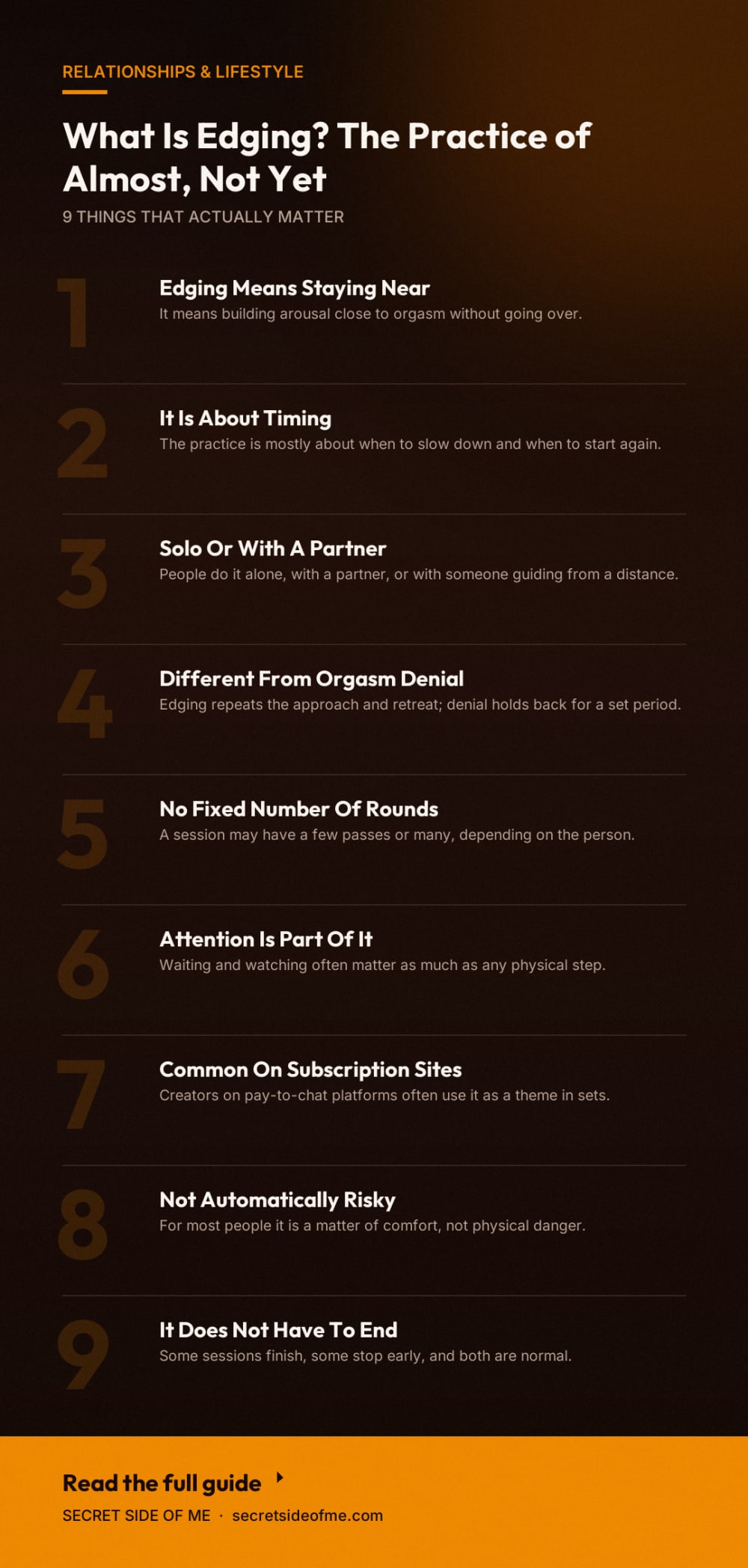
The word edging sounds more dramatic than the practice usually is. It comes down to pacing, paying attention, and choosing when to stop and start again. Some people like it, some try it once and move on, and both of those are fine outcomes.
If you come across it in a caption or a chat and want to know what it means, the short answer is this: staying near the edge on purpose, for as long as the person involved wants to.